
Working with dates and times is essential in programming, and Java provides a strong solution with its java.time package. In this package, the LocalDate class is often used to handle dates, and Epoch time, also called Unix time, is a standardized way to represent time. This article delves into the techniques employed for converting data between Java LocalDate and Epoch time.
1. Difference between Epoch Time and LocalDate
Epoch time and LocalDate represent time in distinct ways, and understanding their differences is crucial for effective time management in Java programming.
| Characteristic | Epoch Time | LocalDate |
| Definition | Number of seconds since Unix Epoch (January 1, 1970, 00:00:00 UTC) | Represents a date without time or time zone |
| Granularity | Measures time at the second level | Represents only the date, ignoring time components |
| Usage | System-level timestamps, data interchange, and precise time calculations | Dates without considering specific times of day |
| Time Zone Dependency | Typically represents time in UTC, but can incorporate local time zone offsets | Does not store time zone information; represents dates in the proleptic Gregorian calendar |
| Handling Time | Precise timing calculations and durations between two points in time | Focused on dates; appropriate for scenarios where specific times are irrelevant |
| Java Classes | Often represented by long values; manipulated using java.time.Instant | Represented by java.time.LocalDate class |
2. Converting LocalDate to Epoch
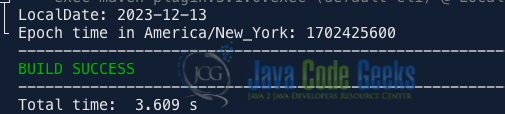
When we have a LocalDate object and need to convert it to Epoch time, we can use the atStartOfDay() method to obtain a LocalDateTime object representing the start of the day and then use the toEpochSecond() method. Here’s an example:
public class LocalDateToEpochExample {

    public static void main(String[] args) {

       // Create a LocalDate object
        LocalDate localDate = LocalDate.now();

        // Specify the desired time zone
        ZoneId zoneId = ZoneId.of("America/New_York");

        // Convert LocalDate to LocalDateTime at the start of the day in the specified time zone
        LocalDateTime startOfDay = localDate.atStartOfDay(zoneId).toLocalDateTime();

        // Convert LocalDateTime to Epoch time (seconds since Unix Epoch)
        long epochSeconds = startOfDay.toEpochSecond(ZoneOffset.UTC);

        System.out.println("LocalDate: " + localDate);
        System.out.println("Epoch time in " + zoneId + ": " + epochSeconds);

    }
}
Let’s break down the code:
LocalDate localDate = LocalDate.now();: This line creates aLocalDateobject representing the current date in the default time zone.ZoneId zoneId = ZoneId.of("America/New_York");: This line creates aZoneIdobject representing theAmerica/New_YorkLocalDateTime startOfDay = localDate.atStartOfDay(zoneId).toLocalDateTime();: This line takes the current date (localDate), sets the time to midnight (start of the day) in the specified time zone, and converts it to aLocalDateTimeobject.long epochSeconds = startOfDay.toEpochSecond(ZoneOffset.UTC);: This line converts theLocalDateTimeobject (startOfDay) to the number of seconds since the epoch (1970-01-01T00:00:00Z) in the UTC time zone. The result is stored in the variableepochSeconds.
2. Converting Epoch to LocalDate
To convert Epoch time to LocalDate, we can use the static method ofEpochSecond() from the LocalDateTime class, followed by the toLocalDate() method. Here’s an example:
public class EpochToLocalDateExample {

    public static void main(String[] args) {
        // Epoch time in seconds
        long epochSeconds = 1702425600;

        // Specify the desired time zone
        ZoneId zoneId = ZoneId.of("America/New_York");

        // Convert Epoch time to LocalDateTime in the specified time zone
        LocalDateTime localDateTime = LocalDateTime.ofInstant(Instant.ofEpochSecond(epochSeconds), zoneId);

        // Extract LocalDate from LocalDateTime
        LocalDate localDate = localDateTime.toLocalDate();

        System.out.println("Epoch time: " + epochSeconds);
        System.out.println("LocalDate in " + zoneId + ": " + localDate);
    }
}
In this example:
- We begin by declaring a variable
epochSecondsthat is assigned a value representing the number of seconds. - Next, a
ZoneIdobjectzoneIdis created to represent theAmerica/New_Yorktime zone. - The
Instant.ofEpochSecond(epochSeconds)creates anInstantobject representing the specified Epoch time. TheLocalDateTime.ofInstantmethod then converts thisInstantto aLocalDateTimein the specified time zone. - Finally, we use the
toLocalDate()method to extract the date component from theLocalDateTime, resulting in aLocalDateobject.
4. Conclusion
In this article, we delved into the process of transforming Epoch time into both LocalDate and LocalDateTime and vice versa. The java.time package provides convenient methods to perform these conversions seamlessly.
5. Download the Source Code
This was an example of Transforming Java LocalDate to Epoch and vice versa.
You can download the full source code of this example here: Transforming Java LocalDate to Epoch and vice versa